· Maya Sinclair
Crystal Singing Bowl Buzzing or Sounding Dull? 6 Bowl-Side Causes, From a Missing O-Ring to a Hairline Crack
Our playing guide ends its troubleshooting section with a line we meant literally: work through the technique checks before assuming the bowl is the problem. This is the page for what comes after, when you have eased your pressure, slowed your circle and given the bowl more rotations than felt reasonable, and the sound is still wrong.
The useful question then changes from what am I doing to what is the bowl touching, what is on its rim, and what is the pad made of right now. Nearly all of those can be answered without tools, and nearly every answer is something you fix on the spot. This guide covers cast quartz bowls, frosted or clear, in the order that finds the culprit fastest.

Which symptom are you hearing? Match it before you touch anything
Different faults make different noises. Listen once with the bowl on its ring and your hands off the wall, then find your row.
| What you hear | Most likely bowl-side cause | Where to look |
|---|---|---|
| A buzz or rattle that comes and goes as the mallet circles | Something touching the wall, or the base on a hard surface without its ring | The base, then the space around it |
| A buzz fixed at one spot on the rim, however you play | Grit on the rim, a chip, or a hairline crack there | Residue, then damage |
| The mallet skates: scraping or squeaking, nothing building | Residue on the rim or pad, or a glazed, worn pad | Residue, then the pad |
| A dull, short, boxed-in tone | Soft material against the wall: a cushion, a lap, a blanket | The base |
| A clean tone that wavers or pulses on its own | A second bowl ringing nearby, or rarely a crack splitting the note | The space around it, then damage |
| It sings, but not the note printed on it | The tuning reference, or the bowl's size | The tuner |
Two symptoms are left out because they are technique and the playing guide owns them: a tone that never starts, and one that wobbles when your angle drifts.
The bowl is sitting on the wrong thing
Start under the bowl: this is the most common bowl-side fault and the fastest to fix. A crystal singing bowl makes its sound with its wall, not the air inside it, and anything pressed against that wall drinks the vibration before it becomes sound. The mechanics are in our guide to why crystal singing bowls sing; in practice, the bowl should touch the world at one narrow band around its base and nowhere else.
That band is what the rubber o-ring in the box provides: it lifts the base off the table and leaves the wall free. Take it away and two things go wrong. On a hard tabletop the flat base chatters every cycle — the rattle that seems to come from nowhere and follows the mallet round. On a soft surface such as a pillow, a blanket or your lap, the material rises up the lower wall and damps it, giving the dull, boxed-in tone that makes a genuine quartz bowl sound like an imitation of itself.
The ring is small and easy to lose: a buyer of our 7-bowl practitioner set reported one missing from the box, and a missing part on arrival is what the guarantee is there to settle.
Average rating across the 58 verified reviews of the Quartzia 7-bowl practitioner set, whose published feedback includes the buyer who reported a missing ring
— Quartzia verified buyer feedback, 2026
So the first check is literal: is the ring under the bowl, centred and flat, and is the surface under it firm and level? A wooden floor, a low table, or a ring-shaped cushion touching only the base all pass; a flat cushion under the whole bowl does not, and neither does your palm while it rings. If the ring has flattened with use, our care guide recommends replacing it.
Something else is touching the wall
Once the base is right, look at everything within reach: a buzz that comes and goes as the mallet circles is almost always a contact buzz. The wall moves outward and back at four places around the rim, and anything resting lightly against one gets tapped hundreds of times a second. Light contact is worse than firm: a bracelet barely grazing the wall chatters against it. The usual suspects:
- Your other hand. Steadying the bowl with a finger on the rim or a palm on the wall is instinctive, and the most common contact of all. Keep the free hand in your lap: a bowl on its ring does not need holding.
- A second bowl. In a set, bowls left close together can touch at a single point, and that point sings back. Give each its own ring and clear space all round.
- The tuner. A phone leaned against the bowl becomes a buzzer the moment the wall moves. Hold it near, never on.
- The case or the spare mallet. A case lid leaning on the wall, or a mallet laid across the rim.
- Jewellery and sleeves. A ring, a watch, a bracelet or a loose cuff brushing the wall as your hand passes.
One pulsing sound is not a contact. If two bowls ring together and the tone swells and fades in a slow, regular rhythm, that is the beat between two close but not identical pitches, and both bowls are fine. To lose the pulse, play one at a time or pair bowls tuned against the same reference — which is why our 3-bowl set is sold as fixed note combinations rather than any three at random.
Residue or moisture on the rim or the mallet head
A tone is made by friction: the pad grips the rim, drags it a tiny distance, lets go, and grips again. Anything that lets the pad slide instead removes the tone at its source, and the sound is unmistakable — a thin scrape or squeak with nothing building underneath, however steadily you circle.
The alternating grip-then-slip friction that drives a bowed string and a rimmed bowl alike; a pad that only slides feeds no vibration
— Hermann von Helmholtz, On the Sensations of Tone, 1863
The things that make a pad slide are the things you cannot see: hand cream, sunscreen, or the oil from a thumb that ran along the rim; the film left by a glass cleaner or polish, one reason our care guide keeps the cleaning list to a microfiber cloth and plain water; dust and grit, which a frosted surface holds more readily than a polished one.
Moisture is subtler. Skin on a wet glass rim sings — that is how the glass armonica in our mechanics guide worked — but a padded mallet is not a fingertip, and our care guidance is to keep the rim dry. What catches people out is condensation: a bowl carried in from the cold fogs over, and rimming it through a damp pad gives an uneven, spitting tone until it clears. Let it reach room temperature and wipe it first.
The fix is the same in every case: wipe the rim and pad with a dry microfiber cloth, wash your hands, and try again. If the scrape turns into a tone within a few rotations, you have found it.
The mallet head itself: worn flat, glazed, gritty, or the wrong end
The pad is the only part of the setup that wears, so it is the first thing to inspect when a bowl that used to sing easily needs coaxing. Check four things in good light.
- A flat spot. A pad rimmed from the same angle every session wears a facet: more surface, less grip, and a tendency to catch and skip. Rotate the mallet so a fresh part meets the rim, and the tone often comes straight back.
- A glazed surface. Pressure polishes the contact face until it is shiny and slick: it looks fine and slides like glass. A glazed pad needs replacing, and our care guide puts a pad check in its seasonal routine.
- Grit in the fibres. A pad set down on the floor picks up grit, and grit against a frosted rim makes a scratchy buzz wherever it sits. Tap it out and brush the pad before playing.
- The wrong end. Late in a long session the bare handle meets the rim instead of the pad. The quartz shrugs it off, but the sound is a clatter, not a tone.
Hardness of quartz on the Mohs scale: why a bowl's wall resists everyday mallet contact, and why the pad is the wear item
— Mohs hardness scale, Friedrich Mohs, 1812
A struck tone tells you about the pad too: if a gentle strike gives a harsh clack instead of a bell, the pad has compressed and meets the rim the way a knuckle would.
A chip or a hairline crack
This is the cause everyone fears first and finds last, and the order is right: it is rare. Cast quartz is hard and dense, and the published reviews of our practitioner set return again and again to how securely the bowls were packed, one buyer describing them as arriving in perfect condition. But a bowl that has been dropped or badly chilled can chip or open a hairline.
The sound gives it away before the eye does, in three ways. It adds a buzz fixed at one spot however you play, and unlike a contact buzz it does not move when you clear the space around the bowl. It shortens the sustain. And it can split the note, so a bowl played alone wavers the way two bowls normally do.
Confirming it takes three senses. Sight along the rim at eye level against a window, turning slowly: a chip shows as a notch in the outline, a hairline as a bright thread catching the light. Run a dry fingertip round the rim and just below it, since a hairline the eye misses will catch a fingertip. Then strike gently at several points: an intact bowl gives the same clean note everywhere, a damaged one dull or rattling near the fault.
A crack is not something to fill, glue or grind down: the fault sits where the wall flexes, anything added there becomes a damper, and a chip leaves a sharp edge. A cracked bowl is one to retire, not repair — and if it arrived that way, that is what the guarantee is for. Every Quartzia order carries a 30-day money-back guarantee, so contact our team and we will arrange a return or a replacement.
Money-back window on every Quartzia order, covering a bowl that arrives damaged or is not what you expected
— Quartzia refund policy, 2026
Prevention is simple: the padded case for any move, one bowl per ring, no sudden temperature shocks.
It sings, but not the note on the box
Sometimes nothing is wrong except the expectation. A bowl that passes every check above yet seems to sound a different note than the listing deserves a measurement before a verdict. Open a free chromatic tuner app, rim the bowl steadily, hold the phone a few inches away without touching the wall, and let the reading settle. Our frequency guide walks through it, and a verified buyer of the 7-bowl set did exactly this and confirmed a bowl on the listed 432 Hz.
The two reference tunings Quartzia bowls are cut to, depending on the note and bowl
— Quartzia product specifications, 2026
Two things commonly explain a surprise. The first is the reference: our bowls are tuned to either 432 Hz or 440 Hz, and an ear used to one hears the other as slightly flat or sharp. The note is the same; the reference is not. The second is size, since a note is set by the bowl's diameter and wall at the moment it was cast, which is why our notes and chakras guide covers which notes come in which sizes. If the tuner genuinely reads a different note from the listing, the guarantee covers it.
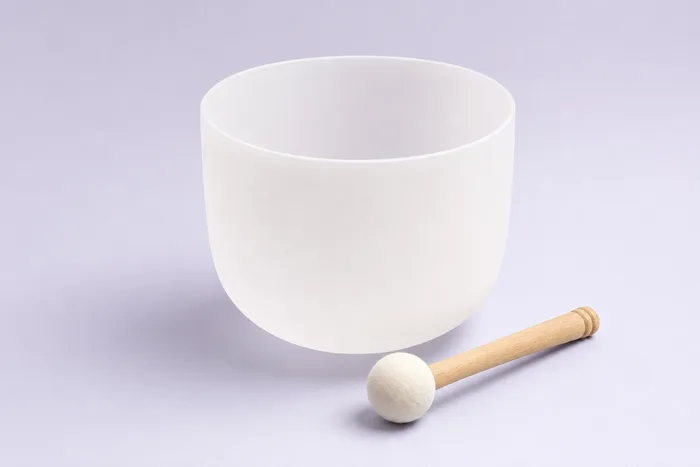
Run those checks before every session and most of this page never applies: ring under the bowl on a firm surface, clear space all round, free hand in your lap, rim and pad wiped dry. If the bowl passes all of it and still sounds wrong, our guide to telling a real crystal singing bowl from a glass look-alike puts the material and sustain tests in order. Every bowl we list has been through our own version of these checks before it earned a place in the catalog, and the single 8-inch bowl ships with the mallet and the o-ring this whole page depends on.
Buzzing, dull, or dying early: FAQ
Why does my crystal singing bowl buzz when I play it?
A buzz that moves as the mallet circles is contact: something is touching the wall, or the base is chattering on a hard surface without its o-ring. A buzz fixed at one spot points to grit, a chip, or a hairline crack there. Check the ring and clear the space around the bowl first.
Why does my crystal singing bowl sound dull?
Almost always because something soft is pressed against the wall: a flat cushion, a lap, a blanket, or a palm. The wall makes the sound, and soft contact absorbs it. Set the bowl on its rubber o-ring on a firm, level surface and keep your free hand off it while it rings.
Can a cracked crystal singing bowl be repaired?
No. A crack sits where the wall flexes most, so filling or gluing it adds a damper exactly where the sound is made. A cracked bowl is retired, not repaired. If a Quartzia bowl arrives damaged, the 30-day money-back guarantee covers it: contact our team for a return or a replacement.
Does humidity affect a crystal singing bowl?
Water does not harm quartz, but condensation or an oily film on the rim changes how the pad grips, and our care guidance is to keep the rim dry. Let a bowl brought in from the cold reach room temperature, wipe the rim and pad dry, then play.

Maya Sinclair · Sound healing practitioner and crystal bowl curator
Maya has practiced sound healing since 2020 and curates Quartzia's frosted quartz bowls, vetting each listing for tone, finish, and shipping durability before it earns a place in the catalog.
Free shipping · 30-day money-back guarantee
More: playing technique, cleaning and care, all guides.