· Maya Sinclair
Why Does a Crystal Singing Bowl Sing?
Circle a mallet around the rim and a bowl that was silent a second ago fills the room. Everything between those two states happens inside the crystal. This page is the mechanical account: what moves, what makes it move, and why the sound behaves as it does.
All of it is the measurable half of the subject. The traditional side of bowl practice is kept deliberately separate, in our notes and chakras guide.
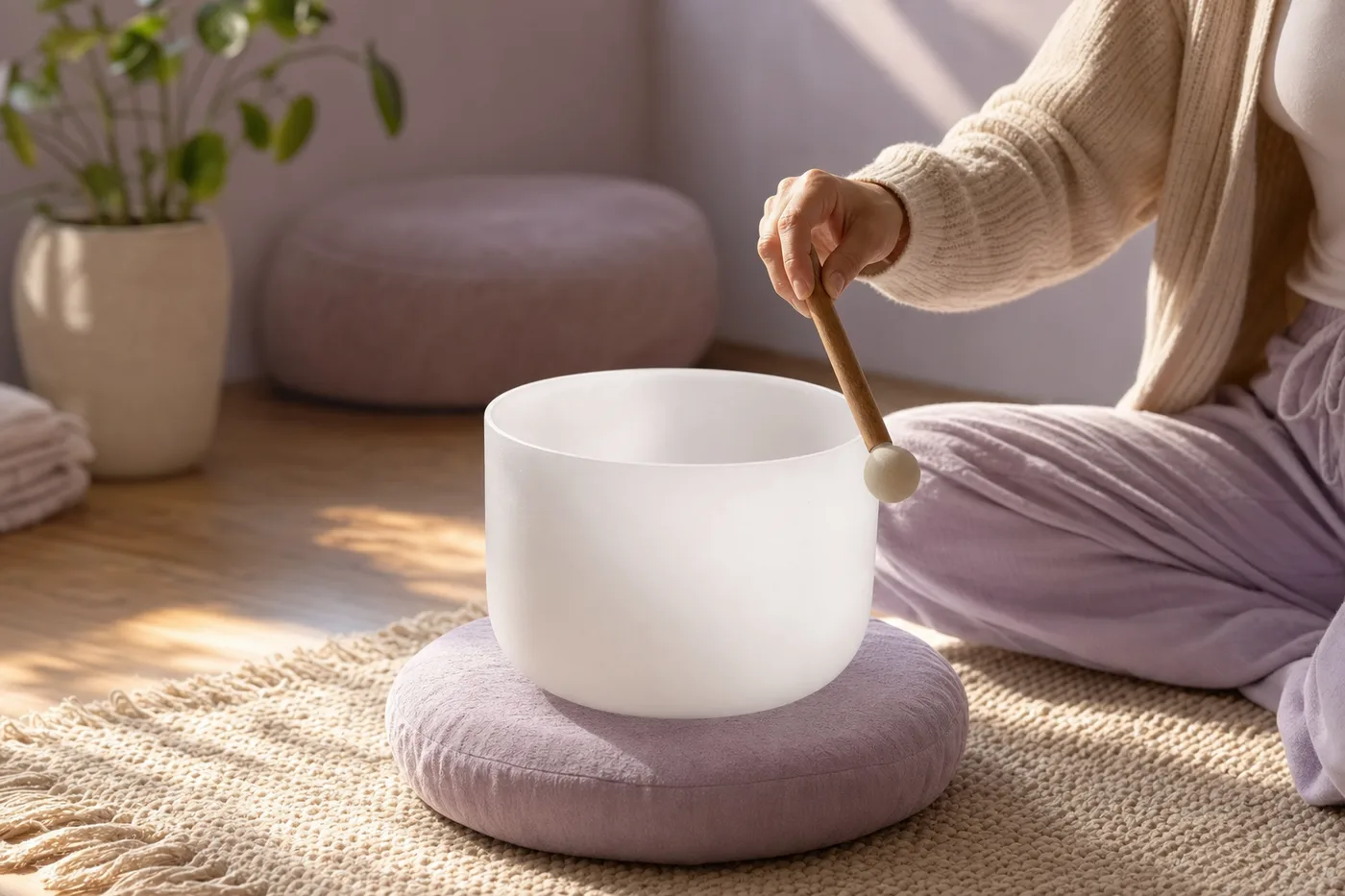
The wall is what vibrates, not the air inside
A singing bowl is not a container that holds a sound. In a flute, a column of air vibrates and the body is just the tube shaping it. A crystal bowl works the other way round: the quartz wall itself bends in and out, and the air is only what gets pushed.
The movement is too small to see. The rim travels a fraction of a millimetre out and back, hundreds of times a second, shoving the surrounding air with it. That is the whole mechanism; nothing resonates in the empty space above the base.
Two everyday observations follow. Cupping a hand over the opening does little, because you have not touched the moving part. Setting the bowl on something thick and soft does a great deal, because an absorbent surface is now pressed against the flexing wall. That is the reason behind a rule our guide to playing a bowl gives as instruction: a firm base, never a lap or a cushion.
Grab, release, repeat: the friction that becomes a tone
A padded mallet pressed against a rim does not glide. It grips, drags the crystal a tiny distance sideways, loses hold when the wall's stiffness pulls back harder than the friction, slips, and grips again. Physicists call this stick-slip friction, and it is one of the most productive noises in music.
It is what a bow does to a violin string, where rosin makes the horsehair grip and release hundreds of times a second rather than slide. Hermann von Helmholtz described that motion in detail in the 1860s.
The alternating grip-then-slip motion by which a bow drives a string, the same mechanism a mallet applies to a rim
— Hermann von Helmholtz, On the Sensations of Tone, 1863
Most people have already heard a version of it: a fingertip drawn round a wet glass rim. A cast quartz bowl adds scale and precision — a chosen pitch, loud enough to fill a room, held for as long as you keep circling.
Here is the surprise. The number of grip-release cycles per second is not set by your hand, which travels round perhaps twice a second. The crystal decides.
Vibrations per second across the seven notes our bowls are tuned to at standard pitch, lowest C to highest B
— Quartzia frequency guide, 2026
The mallet is a supplier of energy, not a metronome. Move it slowly and steadily and you feed the vibration cleanly; move it fast and unevenly and you interrupt your own supply. The pitch is untouched.
Why the rim divides into four moving zones
The rim does not swell outward as one circle. In the lowest and loudest mode of a thin round shell, the ring squashes into an ellipse: two opposite stretches push outward while the two at right angles pull inward, then the pattern swaps. Repeat that swap a few hundred times a second and you have the note.
Counted around the rim, that gives four places moving the most and four, between them, barely moving at all. Lord Rayleigh worked out this family of motion for thin shells and bells in the nineteenth century, and a crystal bowl belongs squarely to it.
The lowest flexural mode of a thin circular shell has four points of maximum movement and four of near-stillness around the rim
— Lord Rayleigh, The Theory of Sound, 1877
This explains a detail that otherwise looks like superstition. The pattern travels with the mallet, locked to the contact point, so a steady circle hands energy to the same mode over and over, in phase. Change the angle halfway round and you stop arriving on time; a tone that was building falls apart. That is the physical reason behind the beginner mistake our playing guide calls a shifting angle.
It also explains why the note comes out clean. An evenly cast wall favours that lowest mode so strongly that everything above it stays faint, which is why a tuner app reads one note rather than a chord. A hand-hammered metal bowl gives its higher modes far more room, which is the tonal difference set out in our crystal versus Tibetan comparison.
Why the tone arrives late, then refuses to leave
Each grip-and-release adds a very small amount of energy to the wall. One is inaudible; the tone you hear is thousands of them stacked up, and stacking takes time. The movement grows rotation after rotation until the energy you add each second equals the energy leaving as sound and heat. Until then the bowl is quiet, and nothing is wrong.
Then the other half. Lift the mallet and the note does not stop, it drains. How fast depends on how much energy the material wastes internally on every flex, and quartz wastes remarkably little: the crystal bends and returns almost elastically, leaving the vibration few ways to escape. That is the origin of the long, clean sustain we list as a defining property of a cast quartz bowl.
It is also why the small rubber ring in the box matters more than it looks. On a hard table, a wide rigid contact patch drains energy every cycle. On the o-ring, contact shrinks to a soft narrow band and the wall keeps moving. Our care guide recommends replacing a flattened o-ring for exactly this reason.
Why playing louder never plays higher
Push harder and the wall swings further from its resting shape. It does not swing faster. The rate is set by the stiffness of the quartz and the mass being moved, both fixed the moment the bowl was cast to its diameter, wall thickness and height.
The consequence is as practical as physics gets. A bowl listed at a given note holds that note whether you play it barely audibly late in the evening or firmly at the start of a session. Volume is yours to choose; pitch is not, and that is a feature. It is what makes a tuned bowl a reliable instrument rather than an ornament that happens to make noise, and what lets a tuner app read the same note back at any volume you like. Size, note and tuning reference are laid out together in our frequency guide.
Internationally standardized concert pitch (ISO 16), the reference a bowl's note is tuned against unless it is tuned to 432 Hz instead
— International Organization for Standardization, 1955
Two bowls at once, and the pulse between them
Play two bowls whose pitches sit close but not identical and the combined sound swells and fades in a slow, regular pulse. Neither bowl is misbehaving. Two vibrations at slightly different rates drift in and out of step, reinforcing one moment and cancelling the next, and the pulse repeats at exactly the difference between them: bowls two cycles per second apart pulse twice a second.
Said plainly, that pulse describes what the air is doing between two objects. It is not a claim about what it does to a listener.
It is useful when choosing, too. Bowls tuned against the same reference stack cleanly into chords, while bowls gathered from unrelated sources can pulse against each other in a way nobody chose. That is why our 3-bowl set is sold as fixed size-and-note combinations rather than any three at random, and why the seven-bowl practitioner set runs a full graduated octave.
The rubbed-glass instrument that came first
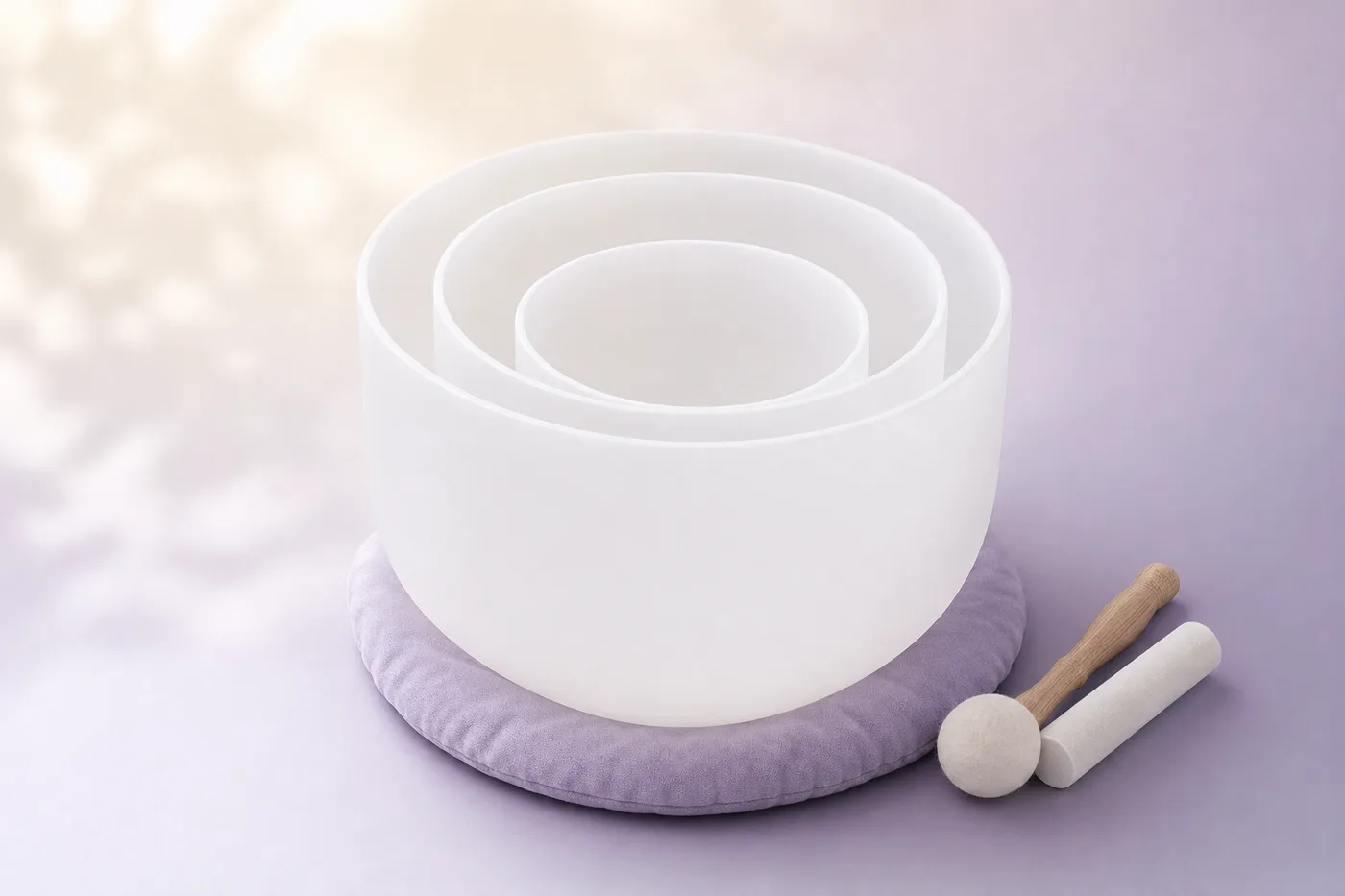
None of this is modern. In 1761 Benjamin Franklin built an instrument from nested glass bowls threaded on a horizontal spindle, turned by a foot treadle and played by touching wet fingers to the rims as they rotated. He called it the armonica, and described it in a letter the following year.
Year Benjamin Franklin built the glass armonica, nested glass bowls sounded by friction on their rims
— Benjamin Franklin, letter to Giambattista Beccaria, 1762
It travelled European concert halls for decades, and Mozart wrote for it. Every element of the physics on this page was already at work: friction gripping and releasing glass, a rim flexing into its lowest mode, a long unforced sustain no struck instrument could match.
Two things changed between that instrument and a bowl on your floor: the wet fingertip became a padded mallet, far easier to control, and blown glass sorted by ear became quartz cast to a target size, which is what turns a specific note into a property you can buy.
What the mechanics change about choosing a bowl
- Pitch is chosen at purchase, not at play. No technique moves a bowl's note, so pick the note first. Our single 8-inch bowl comes in all seven.
- Sustain is the material's doing. A well-cast quartz wall holds the tone for you; you supply a steady hand and a firm surface.
- Contact is the enemy of volume. Keep the o-ring under the bowl and your hands off the wall while it rings.
- More bowls means intervals. Own two tuned to the same reference and chords and pulses become available.
If you are starting out, the single 8-inch bowl is the whole mechanism in one object, ships with the mallet and the o-ring, and carries a 30-day money-back guarantee. Verified buyer feedback sits on our reviews page.
How a singing bowl works: FAQ
Does moving my hand faster around the rim raise the note?
No. Your hand circles once or twice a second; the crystal vibrates hundreds of times a second. Hand speed controls how reliably the friction feeds the vibration, not the pitch it feeds.
Why does my bowl go quiet when I hold it in my hand?
Because the sound is the wall moving, and your palm is pressed against the wall. Soft, heavy contact absorbs that movement. It is also why the bowl sits on a rubber o-ring rather than flat on a table.
Can a crystal bowl produce more than one pitch at once?
It produces one strongly dominant pitch plus much fainter higher modes. An evenly cast wall favours its lowest mode so heavily that a tuner app reads a single clear note.
Is a struck bowl vibrating differently from a rubbed one?
The bowl moves in the same shapes either way. A strike delivers all its energy at once and lets it drain; rubbing keeps topping it up, which is why one fades and the other holds.

Maya Sinclair · Sound healing practitioner and crystal bowl curator
Maya has practiced sound healing since 2020 and writes Quartzia's guides to playing, tuning and caring for frosted quartz singing bowls.
Free shipping · 30-day money-back guarantee
More: playing technique, what bowls are used for, all guides.