Crystal Singing Bowl Frequencies Explained
This page is a plain-language reference for the physics and history behind those numbers: where 432 Hz and 440 Hz actually come from, how a bowl's size determines its note, and a full note-to-frequency table you can use to pick a bowl by ear rather than by guesswork. If you're choosing between our sets rather than a single note, see our set comparison guide; if you want the chakra meaning behind each note, see our sound healing guide.
Where Do 432 Hz and 440 Hz Actually Come From?
Concert pitch wasn't always standardized. In 1859, the French government's "diapason normal" decree fixed a reference pitch of 435 Hz — an early attempt to stop orchestras and instrument makers from drifting to ever-higher pitches. Composer Giuseppe Verdi, among others, argued the French standard was already too high for singers and proposed a lower "scientific pitch" of roughly 432 Hz to Italian authorities in 1884. Neither number won outright: by the mid-20th century, an international conference settled on 440 Hz as the standard, later codified as ISO 16 in 1955, and that's the reference most instruments, orchestras, and tuning apps still use today. 432 Hz survived as a minority alternative, and it's the number modern sound-healing bowls and apps use when they advertise "432 Hz tuning."
Does the Choice Actually Matter?
You'll see strong claims online that 432 Hz is uniquely "in tune with nature" or produces measurably different physiological effects than 440 Hz. That specific claim is not backed by a controlled, peer-reviewed study. What holds up: 432 Hz rings very slightly lower than 440 Hz for the same note, which some listeners describe as rounder or calmer, while 440 Hz matches the tuning of standard instruments and most digital tuners, which matters if you're layering a bowl with other music. Our single bowl and 3-bowl set are both available in either tuning specifically so this stays your choice, not ours.
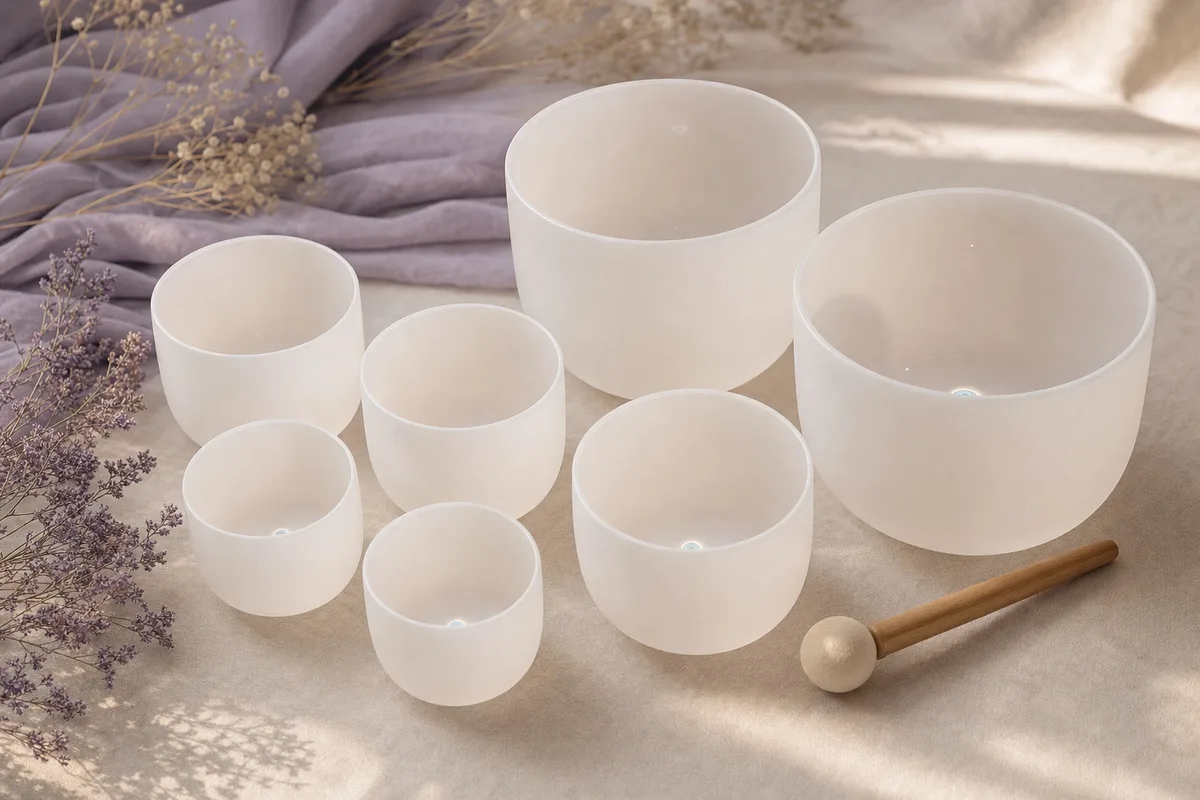
How Bowl Size Sets the Note (and the Frequency)
The table below shows the standard 440 Hz frequency for each note in the octave our bowls use, plus the equivalent frequency if that same note is tuned to 432 Hz instead — calculated by scaling every note by the same 432/440 ratio used to tune the reference note A. It's simple math, but it's not something most singing-bowl listings actually show you.
| Note | 440 Hz tuning | 432 Hz tuning | Typical bowl size |
|---|---|---|---|
| C | 261.6 Hz | 256.9 Hz | 11"–12" (lowest) |
| D | 293.7 Hz | 288.3 Hz | 10"–11" |
| E | 329.6 Hz | 323.6 Hz | 9"–10" |
| F | 349.2 Hz | 342.9 Hz | 8"–9" |
| G | 392.0 Hz | 384.9 Hz | 8" |
| A | 440.0 Hz | 432.0 Hz | 7"–8" |
| B | 493.9 Hz | 484.9 Hz | 7" (highest) |
Sizes are approximate and vary slightly by crystal thickness and casting; they describe the general pattern across our lineup, not an exact spec per bowl. For the exact sizes in each of our sets, see our set comparison.
Matching a Frequency to a Use Case
In practice, most solo meditation buyers pick by note and let 432 vs 440 come down to what sounded better in a demo video, while practitioners who also teach music or work alongside other instruments more often default to 440 Hz for compatibility. Our single-bowl dropdown and our 3-bowl set's 15 combinations both let you choose the tuning directly rather than guessing — see the full combo list on our set page, or the chakra association for each note in our benefits guide.
How to Verify a Bowl's Frequency at Home
This isn't a hypothetical: a verified buyer of the 7-bowl set did exactly this and confirmed a bowl rang true at 432 Hz, the tuning stated on the product page. It's a good habit if you're combining bowls from different sources and want to confirm they're actually in tune with each other before a session.
By the Numbers
Internationally standardized concert pitch (ISO 16), formally adopted as the modern reference for 'standard tuning'
— International Organization for Standardization, 1955
Alternative 'scientific pitch' proposed by composer Giuseppe Verdi to Italian authorities as a lower standard than the French reference of the day
— Historical record of Verdi's petition on concert pitch, 1884
Early official concert-pitch standard set by the French government's 'diapason normal' decree, a direct precursor to today's 440 Hz
— French Academy of Sciences / French government decree, 1859
How the 432 Hz column is calculated: each standard 440 Hz note frequency in the table above is scaled by the same 432/440 ratio used to retune A. If you've seen a "432 Hz frequency chart" elsewhere with different numbers, it's likely using a different base assumption — the ratio is shown here so you can check any note yourself.
Free shipping · 30-day money-back guarantee
Frequency FAQ
What is the difference between 432 Hz and 440 Hz tuning?
They're two different reference points for the note A. 440 Hz is the internationally standardized concert pitch (ISO 16, set in 1955); 432 Hz is a slightly lower alternative tuning with roots in 19th-century pitch history. Every other note in a bowl is tuned relative to whichever reference you pick, so a 432 Hz bowl rings marginally lower across the board than the same note at 440 Hz.
Which frequency should I choose, 432 Hz or 440 Hz?
There's no proven health difference between the two — it comes down to what you find pleasant to listen to and, if you play other instruments, which one matches them. 440 Hz matches standard modern instrument tuning; 432 Hz is popular in sound-healing and meditation circles for its slightly lower, some say "warmer," character. Both are legitimate, professionally used tunings.
Does bowl size determine its frequency?
Yes. Larger bowls have a longer resonating chamber and ring at a lower frequency; smaller bowls ring higher. That's why a graduated set runs from a 12" bowl (lowest note) down to a 7" bowl (highest note), and why our 3-bowl set pairs specific sizes with specific notes rather than mixing them randomly.
Is 432 Hz scientifically proven to be more healing than 440 Hz?
No independent, controlled study has shown that 432 Hz produces greater health benefits than 440 Hz — that claim circulates widely online but isn't backed by peer-reviewed evidence. We sell both tunings and let buyers choose based on preference, not on an unproven healing claim.
Want to see how frequency ties into a full home practice? Read our meditation guide, how to play a bowl, how to care for one, and how crystal bowls compare to Tibetan bowls. Or check about Quartzia, our verified reviews, and the full bowl lineup. Questions? Contact us — or browse the full blog.