· Maya Sinclair
Which Singing Bowl Note Matches Each Chakra?
The mapping takes one line to state. What costs people money is everything after it: whether bowl size limits which note you can buy, and whether a colored bowl sounds different from a plain frosted one.
What is measurable here, and what is tradition?
Two very different kinds of claim get folded together on most pages about this topic. The note is measurable: a crystal bowl rings at a pitch you can read with a free chromatic tuner app, the same way you would check a guitar string. That pitch is a physical property of the object, set by the bowl's size and the way the quartz was cast.
The chakra is tradition. The seven-note to seven-chakra mapping is a convention used inside sound-healing and yoga practice, well established there and useful as a focus, in the way a breath count gives a session a shape. It is not the output of a measurement, and no note has been shown to act on a specific part of the body. We are a bowl shop with no medical standing, so we describe it as what it is. Our sound healing guide covers where the practice sits relative to the research that exists.
Which note is matched to which chakra?
From the lowest note upward: C is matched to the root chakra, D to the sacral (listed as the navel chakra on our product page), E to the solar plexus, F to the heart, G to the throat, A to the third eye, and B to the crown.
The logic of that sequence explains why it is so easy to remember: the chakras are described as sitting along the body from the base of the spine to the top of the head, and the notes rise in the same order. It is an ordinal correspondence, one ordered list matched to another, not a physical link between a frequency and a piece of anatomy. The full table, with the color and usual focus for each note, sits on our sound healing guide.
Why the bowl's size decides which note you get
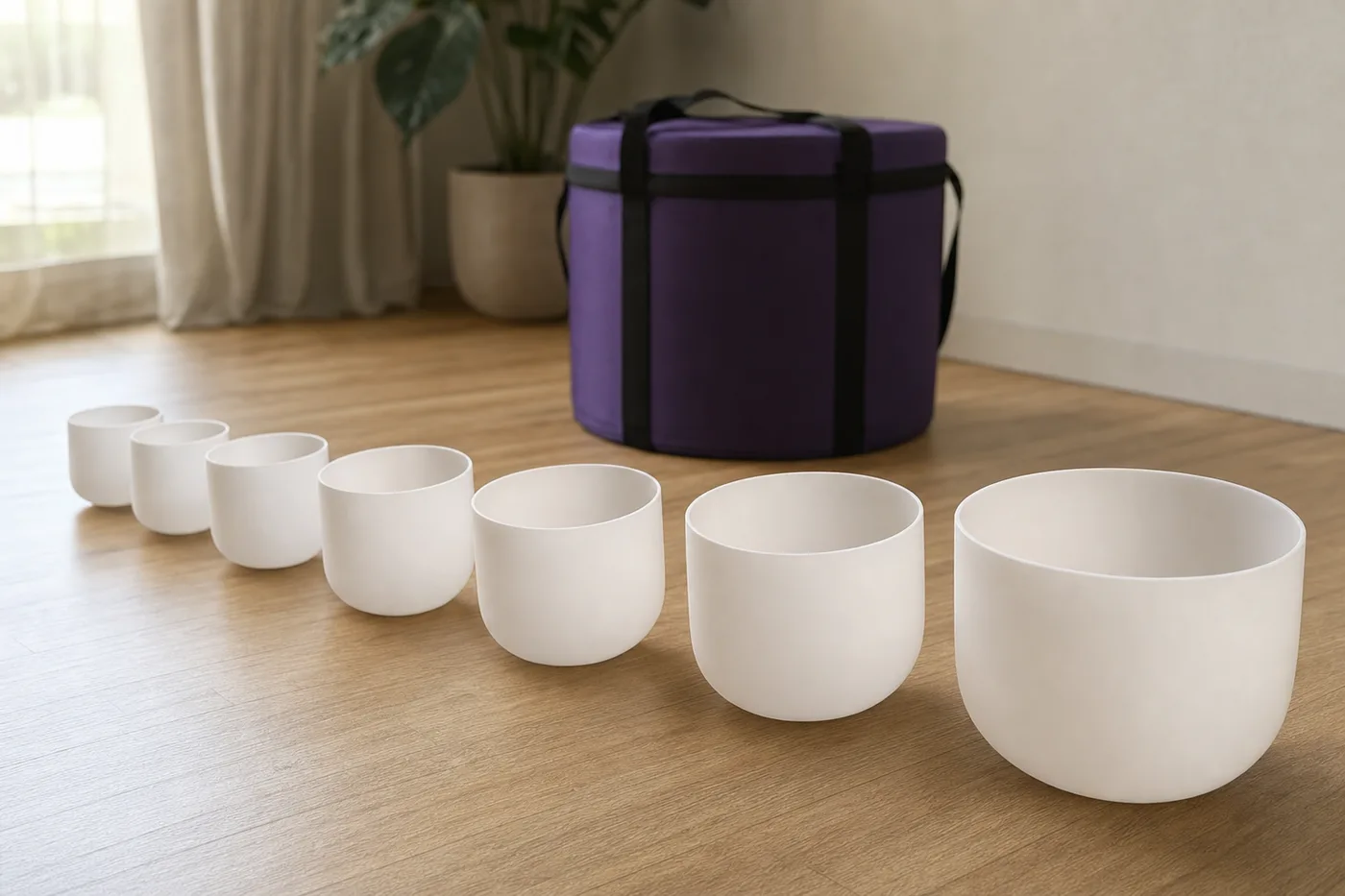
Bigger bowl, lower note. That is why a graduated practitioner set is sold as seven different sizes rather than seven identical bowls, and you can see it above: as the bowls step up in diameter, the pitch steps down.
Diameter range across the seven bowls in our graduated set, from the highest note to the lowest
— Quartzia product catalog, 2026
Diameter is the main driver, but not the only one. Wall thickness and bowl height also move the pitch, which is why our single 8-inch bowl is offered in all seven notes: a graduated set uses size to step through the scale, while a single bowl adjusts the casting so one size covers the range. It is also why the size ranges in our frequency guide are called typical rather than exact. That page holds the note-to-Hertz table and the 432 Hz question, a decision separate from the note.
Internationally standardized concert pitch (ISO 16), the reference every note in a bowl is tuned against unless the bowl is tuned to 432 Hz instead
— International Organization for Standardization, 1955
The note you want may not come in the size you want
On a single bowl this does not bite: all seven notes come in the 8-inch size. On a 3-bowl set it becomes real, because the set is not sold as any trio you like.
Real size, note and tuning combinations the 3-bowl set is actually sold in, which is why certain notes only appear on certain bowl sizes
— Quartzia product catalog, 2026
Read the combination list on our set guide and a pattern shows up. The 10-inch bowl appears as C, D, E or F. The 8-inch appears as E, F or G. The 6-inch appears as G, A, B or C. So if your practice is built around A, you will find it on the 6-inch bowl and never on the 10-inch.
So decide which notes matter first, then find the combination containing them, rather than picking a combination and hoping your note is in it. If none of the fifteen holds the pair you want, a single bowl in that note is usually cheaper than compromising.
Does the bowl's color have to match the chakra?
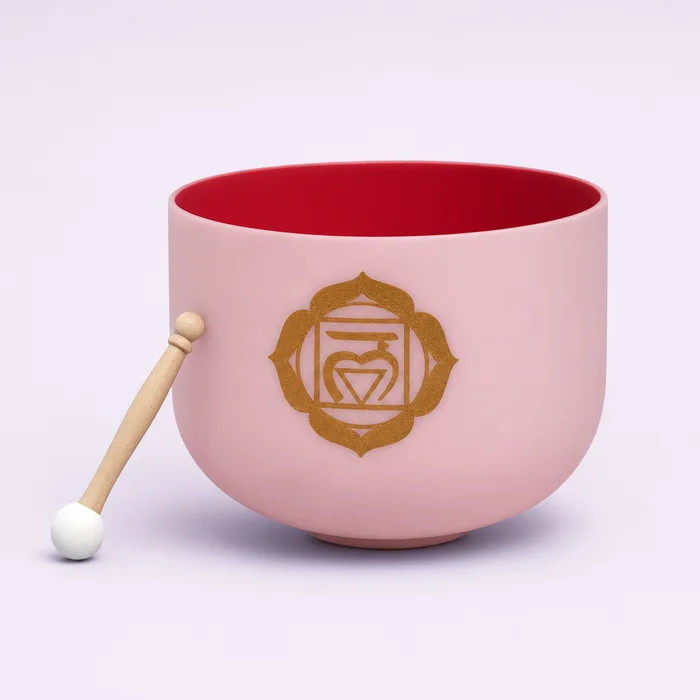
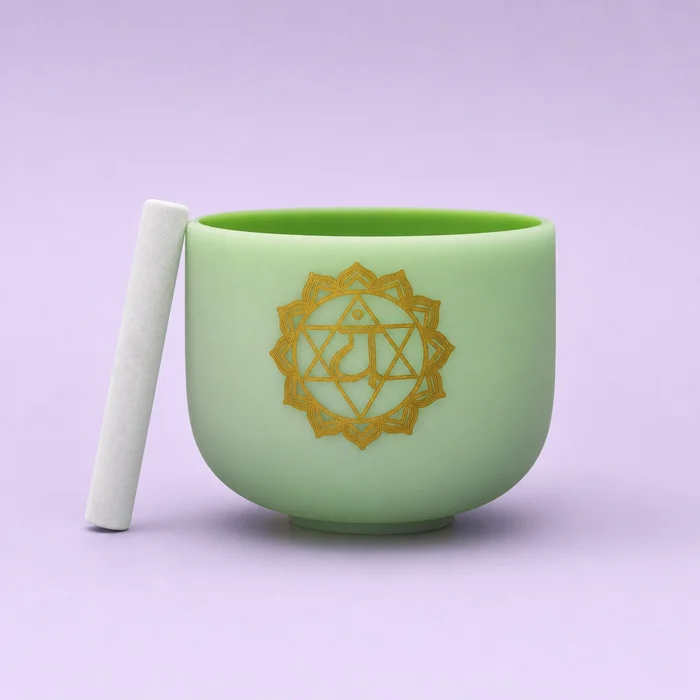
Every single bowl is cast in a color tied to its note, engraved with the matching chakra symbol in gold. C is pink with a red interior, D orange, E yellow, F green, G light blue, A lavender, B white. The bowl above is our C, and the engraving on it is the root chakra symbol.
The color is a visual cue, not an acoustic one. Two bowls of the same size and casting ring at the same note whether the quartz is tinted or left frosted white, so nobody should pay for a color expecting a different sound out of it.
That matters for one practical reason: our 3-bowl and 7-bowl sets are frosted white or clear quartz throughout, with no color coding and no engraved symbol, as the lineup at the top of this page shows. If color is how you keep track of which bowl is which mid-session, that argues for single bowls. If only the tone matters, the sets give you more bowls for the money.
Which note should a first bowl be?
There is no correct answer, and any page that hands you one is guessing on your behalf. Three grounds are not guesswork, though.
If you already practice with a teacher, use the note they use: matching what you hear every week beats any chart. If you are choosing on sound alone, listen before you read, since low notes are rounder and fill a room while high notes are brighter in a small space. If you are choosing on the chakra association, pick the intention you genuinely want to sit with rather than the one that reads most impressively.
Our single 8-inch bowl is $99.99, ships with a wooden mallet and a rubber O-ring stand, and arrives in 8 to 10 business days with free US shipping and a 30-day money-back guarantee. That guarantee is the real safety net: if the note you chose does not suit you once it is in the room, you are not stuck with it.
Do you actually need all seven notes?
Most home practices never do. One note played often does more than seven rotated at random, which is why our meditation practice guide and our guide to playing a bowl are both built around a single bowl. Three notes are where short progressions become possible; seven are a practitioner's tool for a full octave.
That seven-bowl set is our only product with a real review history, at 4.8 out of 5 across 58 verified buyers, one of whom checked the tuning and wrote: "Well packed and perfectly 432Hz tuned. I checked one bowl with a tuner myself and it matched. Good." Our other two listings are newer and have no comparable review base. See the reviews page, how we test, or the full lineup.
Notes and chakras FAQ
Is there scientific evidence that a specific note affects a specific chakra?
No. We have found no controlled research showing that one musical note acts on one part of the body. The mapping is a practice convention, useful as a focus rather than as a physiological claim.
Does choosing 432 Hz or 440 Hz change which chakra a note belongs to?
No. A C bowl is a C bowl in both tunings. 432 Hz simply places every note slightly lower, because the whole scale shifts with its reference pitch. Our frequency guide covers that choice separately.
Can one bowl be used for more than one chakra?
Nothing stops you. The traditional mapping assigns one note per chakra, but plenty of home practitioners own a single bowl and use it for every session regardless of the focus.
What if my bowl does not sound like the note printed on it?
Check it with a free chromatic tuner app first: rim the bowl steadily and let the reading settle. If it genuinely does not match, that is what the 30-day money-back guarantee is for.

Maya Sinclair · Sound healing practitioner and crystal bowl curator
Maya has practiced sound healing since 2020 and curates Quartzia's frosted quartz bowls, vetting each listing for tone, finish, and shipping durability before it earns a place in the catalog.
Free US shipping · 30-day money-back guarantee
More: what bowls are used for, care, all guides.